
Is your child ready to learn division? Make mathematics fun with cookies, toys, LEGO bricks, and simple sharing games! These early division activities for Grade 1 and 2 help children understand equal groups, fair sharing, and leftovers through everyday experiences.
Introduction: Division Begins with Fair Sharing!
When parents hear the word division, they often imagine complicated mathematical calculations, long division, and difficult formulas. But children can start understanding the foundations of division much earlier through simple everyday activities.
The secret is FAIR SHARING!
Children naturally understand fairness. If one child gets four biscuits, they expect their friend to receive the same number.
This simple idea is the foundation of early division.
Before introducing the division symbol (÷), help your child understand that division means taking a total number of objects and sharing them equally into smaller groups.
Here are five fun and practical ways to introduce division at home.
- Introduction: Division Begins with Fair Sharing!
- 1. What Is Early Division? The "One for You, One for Me" Game
- 2. Sharing vs. Grouping: Two Ways to Understand Division
- 3. What Happens to the Leftover Crumbs? Understanding Remainders
- 4. The Multiplication and Division Mirror Secret
- 5. Make Learning Fun with Equal-Sharing Worksheets
- 6. Quick Two-Minute Division Challenge!
- Give Your Child a Head Start with MastiBee!
- Frequently Asked Questions (FAQs)
1. What Is Early Division? The “One for You, One for Me” Game
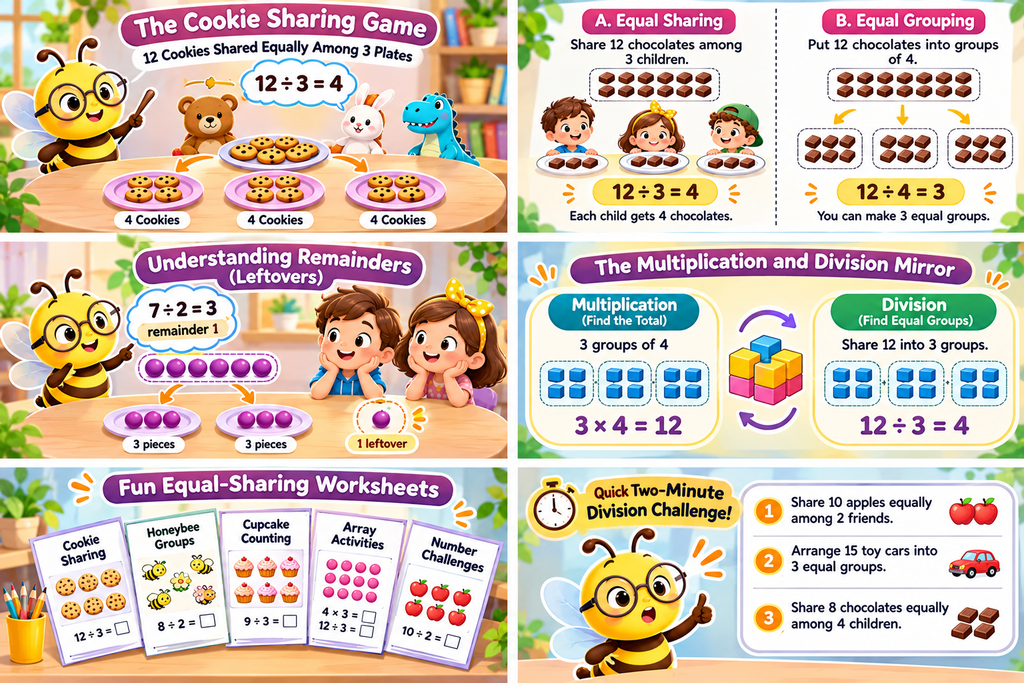
The easiest way to introduce division is through a cookie-sharing activity.
What you need:
- 12 cookies, counting bears, or colourful buttons.
- 3 small paper plates.
- 3 toy characters or dolls.
How to play:
- Place all 12 cookies in the centre of the table.
- Give each toy character one empty plate.
- Ask your child to distribute the cookies equally.
- Follow the rule: One for the first plate, one for the second, and one for the third.
- Repeat until all the cookies are distributed.
What will your child discover?
- Plate 1 gets 4 cookies.
- Plate 2 gets 4 cookies.
- Plate 3 gets 4 cookies.
Ask your child: “Does everyone have the same number of cookies?”
Yes! Everyone gets four cookies.
Now introduce the mathematical expression:
12 ÷ 3 = 4
Explain that 12 cookies were shared equally among 3 plates, so each plate received 4 cookies.
This activity teaches division through hands-on learning rather than memorising formulas.
2. Sharing vs. Grouping: Two Ways to Understand Division
Children should understand that division can be used in two different situations.
A. Equal Sharing
Imagine you have 12 chocolates and want to share them equally among 3 children.
How many chocolates will each child receive?
12 ÷ 3 = 4
Each child receives 4 chocolates.
B. Equal Grouping
Now imagine you have 12 chocolates and want to put exactly 4 chocolates into each packet.
How many packets can you make?
12 ÷ 4 = 3
You can make 3 equal packets.
Try this at home: Use LEGO bricks, toy blocks, or buttons to demonstrate both activities. Let your child arrange the objects independently.
3. What Happens to the Leftover Crumbs? Understanding Remainders
Not every number can be shared equally. This is a great opportunity to introduce the idea of leftovers.
The activity:
- Take 7 grape pieces or 7 toy counters.
- Ask your child to share them equally between 2 toy characters.
- Give one piece to each character in turns.
- Continue until only one piece remains.
Now count the objects:
- Character A gets 3 pieces.
- Character B gets 3 pieces.
- 1 piece remains.
Ask: “Can we share the last piece equally between both friends?”
Explain that the extra piece is called a remainder.
The mathematical expression is:
7 ÷ 2 = 3 remainder 1
For younger children, focus on understanding the leftover object before introducing formal remainder notation.
4. The Multiplication and Division Mirror Secret
Did you know multiplication and division are closely connected?
Help your child discover this relationship using groups of objects.
First, arrange 12 colourful blocks into 3 groups of 4.
Multiplication:
3 groups of 4 make 12.
3 × 4 = 12
Division:
12 blocks shared equally among 3 groups gives 4 blocks in each group.
12 ÷ 3 = 4
Explain that multiplication combines equal groups to find a total, while division separates a total into equal groups.
This connection helps children build confidence when learning multiplication tables and division facts.
5. Make Learning Fun with Equal-Sharing Worksheets
Hands-on activities are an excellent starting point, but children also need regular practice to strengthen their understanding.
Try these simple worksheet activities:
- Cookie Sharing: Draw equal numbers of cookies on different plates.
- Honeybee Groups: Help cartoon honeybees distribute flowers equally among their hives.
- Cupcake Counting: Divide cupcakes equally among friendly monsters.
- Array Activities: Arrange objects in rows and columns to identify equal groups.
- Number Challenges: Solve simple division problems using pictures and counting objects.
Encourage your child to draw, count, colour, and explain their answers instead of simply memorising them.
6. Quick Two-Minute Division Challenge!
Ready to test your child’s understanding?
Give your child these three questions:
- Share 10 apples equally among 2 friends. How many apples does each friend get?
- Arrange 15 toy cars into 3 equal groups. How many cars are in each group?
- Share 8 chocolates equally among 4 children. How many chocolates does each child receive?
Answers:
- 5 apples each.
- 5 cars in each group.
- 2 chocolates each.
Celebrate every attempt! The goal is to develop mathematical thinking, not speed.
\
Give Your Child a Head Start with MastiBee!
Learning mathematics should be an exciting adventure, not a stressful experience.
The MastiBee Grade 1 Math Workbook makes early mathematics engaging through colourful illustrations, interactive exercises, and age-appropriate learning activities.
Inside, children can explore:
- Equal sharing and early division.
- Array multiplication activities.
- 120-chart number mazes.
- Singapore bar models.
- Fun counting and problem-solving exercises.
Give your little learner an opportunity to practise mathematics through playful activities at home.
Ready to make maths more enjoyable?
Explore the MastiBee Grade 1 Math Workbook and get your instant printable PDF for just ₹149.
👉 Explore the MastiBee Math Workbook
Frequently Asked Questions (FAQs)
1. At what age should children start learning division?
Children can begin understanding the foundations of division around ages 6–8 through equal-sharing activities, counting objects, and grouping games. Formal expectations vary by curriculum and individual learning progress.
2. How do I explain division to a Grade 1 student?
Start with physical objects such as cookies, pencils, toys, or buttons. Ask your child to distribute them equally among friends or plates. This makes division easier to understand.
3. What is the difference between sharing and grouping in division?
Sharing means distributing a known total equally among a given number of groups. Grouping means finding how many equal-sized groups can be made from a known total.
4. How can I teach remainders to young children?
Use small objects such as buttons or toy blocks. Ask your child to share them equally and identify any objects left over. Explain that these extra objects are called remainders.
5. Are worksheets helpful for learning early division?
Yes! Worksheets reinforce concepts introduced through hands-on activities. Picture-based exercises, equal-grouping questions, and simple number challenges help children practise independently.
Make every little learning moment count with MastiBee!