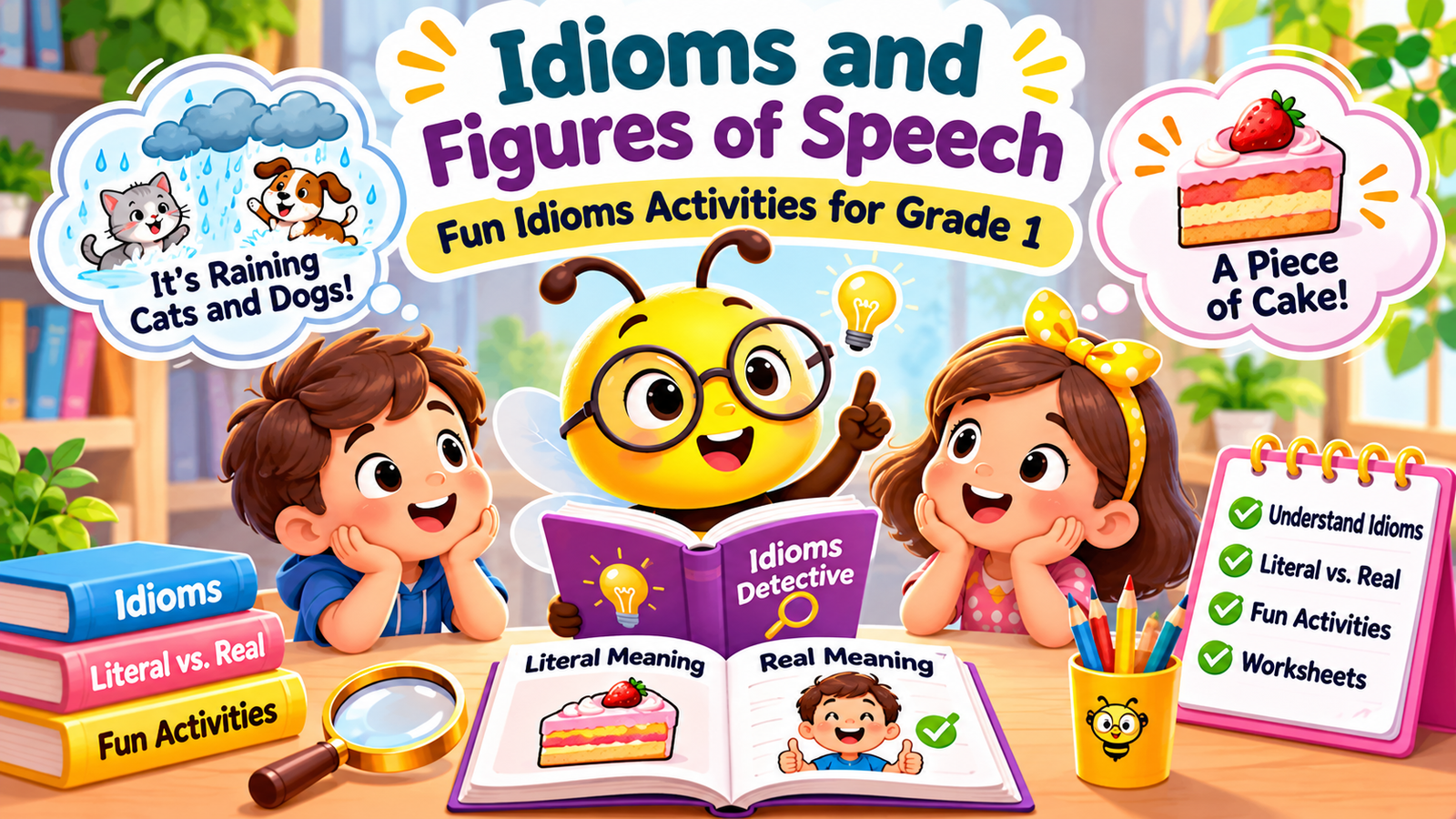
Have you ever told your child, “It’s raining cats and dogs,” only to see them look outside for flying puppies and kittens? Children often understand words literally before they learn that phrases can have hidden meanings!
These fun idioms activities for Grade 1 help young readers understand figurative language through funny examples, colourful illustrations, drawing games, and everyday conversations.
- Introduction: When Words Have Secret Meanings!
- 1. What Is an Idiom? The Secret Code Game
- 2. Play the Literal vs. Real Meaning Cartoon Game
- 3. Top 5 Everyday Idioms Every Grade 1 Child Can Learn
- 4. Try the Family "Idiom Alert" Challenge!
- 5. Practise with Idiom Matching and Comic Strip Worksheets
- 6. Quick Idiom Detective Challenge!
- Make English Learning an Adventure with MastiBee!
- Frequently Asked Questions (FAQs)
Introduction: When Words Have Secret Meanings!
Imagine a teacher saying:
“Zip your lips, put on your thinking caps, and take out your books. This test will be a piece of cake!”
A young child might wonder: Where is the zipper? Where is my thinking cap? And why would there be cake during a test?
This is because children are still developing their understanding of figurative language.
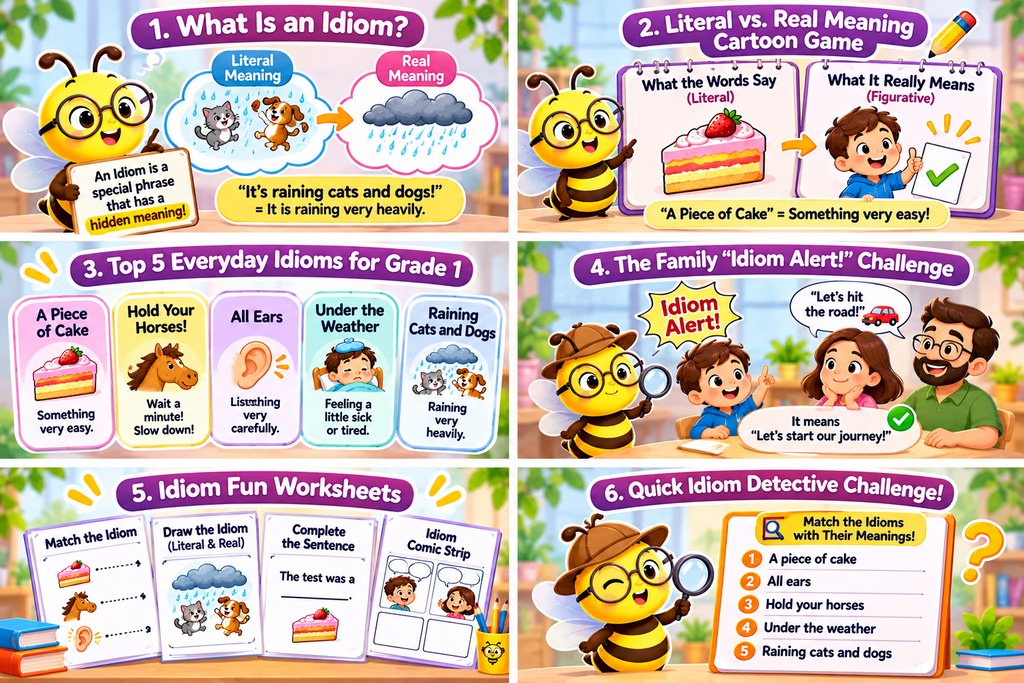
An idiom is a group of words that has a special meaning different from the literal meaning of the individual words.
For example, when someone says, “It’s raining cats and dogs,” they don’t mean that animals are falling from the sky. They simply mean that it is raining very heavily!
Learning idioms helps children develop reading comprehension, understand everyday conversations, and enjoy the humour hidden in stories.
Here are five fun ways to introduce idioms and figures of speech to your Grade 1 learner.
1. What Is an Idiom? The Secret Code Game
Think of idioms as secret language codes!
Explain to your child that some phrases have two meanings:
- Literal meaning: What the words actually say.
- Figurative meaning: What the speaker really wants to express.
Let’s try an example.
Idiom: It’s raining cats and dogs!
Literal meaning: Imagine cute puppies and kittens falling from the clouds!
Real meaning: It is raining very heavily.
Ask your child to imagine the funny picture first. Then reveal the real meaning.
This simple comparison makes unfamiliar expressions easier to understand and remember.
2. Play the Literal vs. Real Meaning Cartoon Game
Turn idiom learning into a creative drawing activity!
What you need:
- A blank sheet of paper.
- Colourful crayons or pencils.
- A few familiar idiom phrases.
How to play:
- Draw a vertical line down the middle of the paper.
- Label the left side “What the Words Say.”
- Label the right side “What It Really Means.”
- Choose one funny idiom and ask your child to illustrate both meanings.
Example: A Piece of Cake
- Literal picture: Draw a delicious slice of strawberry cake.
- Real meaning: Draw a happy child solving an easy puzzle.
Explain that “a piece of cake” means something is very easy to do.
Encourage your child to create their own funny drawings. The more imaginative the pictures, the more memorable the learning experience!
3. Top 5 Everyday Idioms Every Grade 1 Child Can Learn
Start with simple expressions that children may hear at home, in school, or in storybooks.
1. A Piece of Cake
Meaning: Something that is very easy.
Example: “That puzzle was a piece of cake!”
2. Hold Your Horses!
Meaning: Wait a moment or slow down.
Example: “Hold your horses! We haven’t finished packing.”
3. All Ears
Meaning: Listening very carefully.
Example: “Tell me your story. I’m all ears!”
4. Under the Weather
Meaning: Feeling a little unwell.
Example: “I am staying home because I feel under the weather.”
5. Raining Cats and Dogs
Meaning: Raining very heavily.
Example: “We cannot play outside because it is raining cats and dogs!”
Parent tip: Ask your child to explain each expression in their own words. Understanding the meaning is more important than memorising the phrase.
4. Try the Family “Idiom Alert” Challenge!
Children learn language naturally when they hear it used in everyday situations.
Turn family conversations into a fun idiom-detective game.
How to play:
- Tell your child that everyone in the family must listen for funny expressions.
- Whenever someone uses an idiom, say “IDIOM ALERT!”
- Ask your child to explain what the expression really means.
- Give one point for every correctly identified idiom.
For example:
Parent: “Let’s hit the road!”
Child: “Idiom alert! It means let’s start our journey!”
Make it a fun family activity during dinner, storytime, or weekend conversations.
5. Practise with Idiom Matching and Comic Strip Worksheets
After introducing idioms through games and conversations, give your child opportunities to practise independently.
Try these engaging worksheet activities:
- Picture Matching: Match each idiom with its correct meaning.
- Funny Illustrations: Draw what an idiom would look like if taken literally.
- Meaning Detective: Read a sentence and identify the hidden meaning.
- Comic Strip Stories: Complete short cartoon conversations using familiar idioms.
- Fill in the Blanks: Choose the correct idiom to complete a simple sentence.
These activities help children connect vocabulary with meaning while developing reading comprehension and creative thinking.
6. Quick Idiom Detective Challenge!
Can your little learner discover the secret meanings?
Ask your child to match these expressions with their meanings.
Questions:
- A piece of cake
- All ears
- Hold your horses
- Under the weather
- Raining cats and dogs
Meanings:
A. Feeling unwell.
B. Listening carefully.
C. Something very easy.
D. Wait a moment.
E. Raining very heavily.
Answers:
- C – Something very easy.
- B – Listening carefully.
- D – Wait a moment.
- A – Feeling unwell.
- E – Raining very heavily.
Celebrate every correct answer and encourage your child to use a newly learned idiom in a sentence!
Make English Learning an Adventure with MastiBee!
Learning English goes beyond recognising letters and memorising words. Children also need opportunities to explore vocabulary, understand expressions, and develop confidence in reading.
The MastiBee Grade 1 English & Reading Workbook makes language learning enjoyable through colourful illustrations and engaging literacy activities.
Inside, young learners can explore:
- Fun idiom detective activities.
- Preposition learning exercises.
- Onomatopoeia and sound-word activities.
- 50 essential sight words.
- Creative reading and vocabulary practice.
Give your child a fun way to discover the magic of words!
Ready to make English learning more exciting?
Explore the MastiBee Grade 1 English & Reading Workbook and get your high-resolution printable PDF for just ₹149.
👉 Explore MastiBee Learning Resources
Frequently Asked Questions (FAQs)
1. What is an idiom in simple words for Grade 1?
An idiom is a group of words that has a special meaning different from what the words literally say. For example, “a piece of cake” means something is very easy.
2. At what age can children start learning idioms?
Children can begin exploring simple idioms around ages 6–7. Use familiar expressions, pictures, stories, and everyday conversations to introduce their meanings.
3. What are some easy idioms for Grade 1 students?
Some beginner-friendly idioms include “a piece of cake,” “hold your horses,” “all ears,” “under the weather,” and “raining cats and dogs.”
4. How can I teach idioms to young children?
Use funny literal pictures, storytelling, matching games, comic strips, and real-life examples. Encourage children to explain what each expression means in their own words.
5. Why should children learn idioms?
Learning idioms helps children understand everyday conversations, improve reading comprehension, build vocabulary, and recognise figurative language in stories.
Little words, big meanings! Make every learning adventure special with MastiBee.