Imagine your child is reading a story about a baseball game. Suddenly, they come across this sentence:
“The boy picked up the bat and hit the ball!”
Your little reader already knows that a bat is a furry animal that flies at night. So they stop and wonder, “Why is someone using a flying animal to hit a ball?”
Funny, right?
Welcome to the world of homographs (multiple-meaning words)!
When children first learn to read, they often connect each word with one familiar meaning. But English has many words that look exactly the same while having completely different meanings.
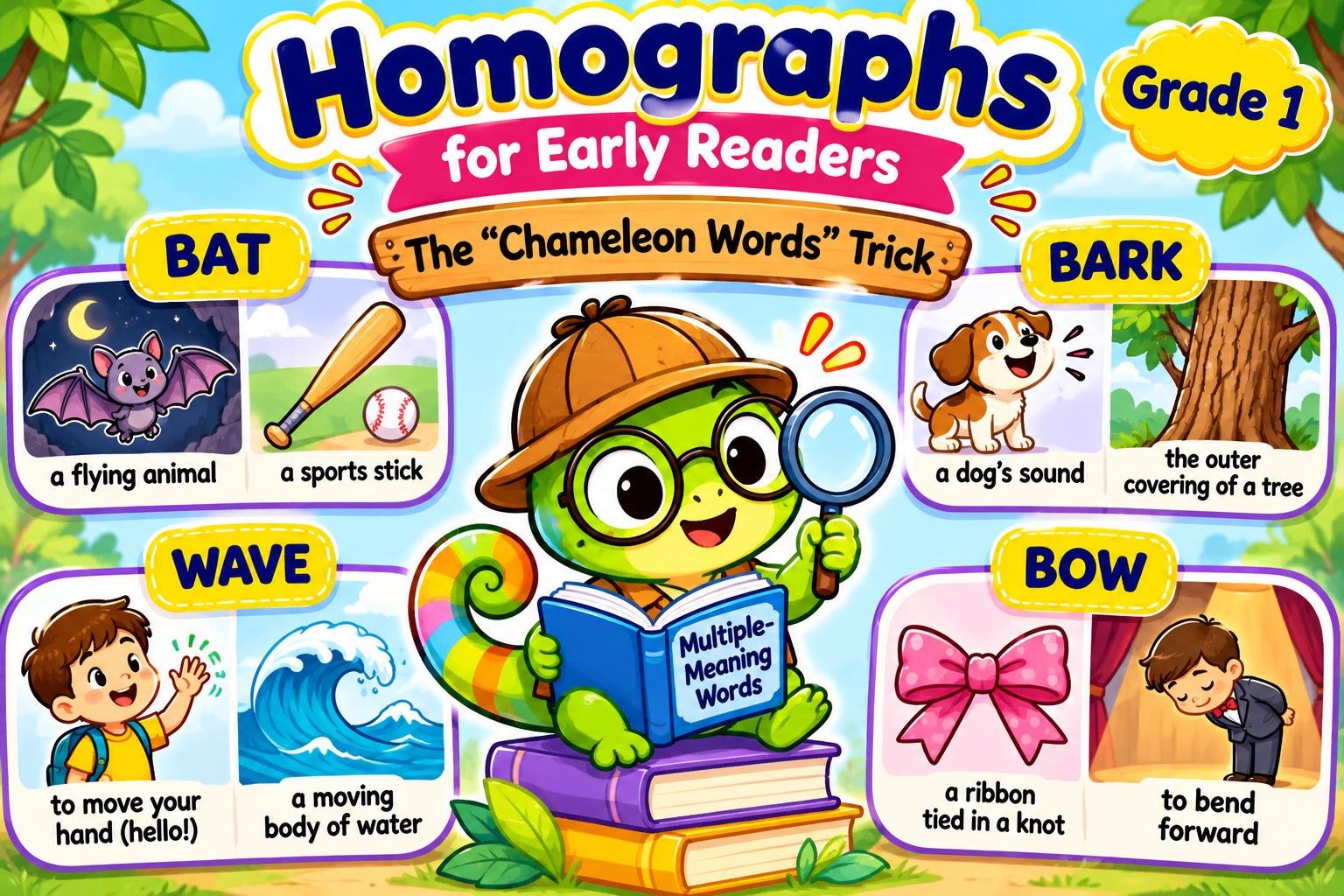
For example, a bat can be a flying animal or a piece of sports equipment. A bark can be a dog’s sound or the rough covering of a tree.
How can we help young readers understand these tricky words?
Let’s introduce the Chameleon Words Method! Through colourful pictures, funny stories, and playful matching games, children can discover how one word can have multiple meanings.
1. What Is a Chameleon Word?
Imagine a chameleon sitting on a green leaf. It changes its colour to blend into its surroundings. When it moves onto a brown tree branch, its colour changes again!
Words can behave in a similar way.
A homograph is a word that has the same spelling as another word but a different meaning.
The letters stay the same, but the meaning changes depending on the sentence.
Let’s look at an example.
The Word: BAT
Meaning 1: A Flying Animal
A bat sleeps upside down in a cave and flies at night.
Meaning 2: Sports Equipment
A baseball player uses a bat to hit a ball.
The word BAT looks exactly the same in both sentences, but its meaning changes!
This is why we call them Chameleon Words.
2. Top 6 Chameleon Words Every Grade 1 Reader Should Know
Let’s explore some everyday words that have more than one meaning.
1. BARK
<Meaning 1: The sound a dog makes.
The little puppy began to bark loudly.
Meaning 2: The rough outer covering of a tree.
The tree has thick, brown bark.
2. WAVE
Meaning 1: Moving your hand to greet someone.
I wave goodbye to my teacher.
Meaning 2: A moving body of water.
A big wave splashed onto the beach.
3. RING
Meaning 1: A piece of jewellery worn on a finger.
Mom wears a beautiful gold ring.
Meaning 2: A sound made by a bell or telephone.
I heard the telephone ring.
4. FLY
Meaning 1: A tiny buzzing insect.
A fly landed on the table.
Meaning 2: To travel through the air.
Birds fly high in the sky.
5. BOW
Meaning 1: A ribbon tied into a decorative shape.
She wore a pink bow in her hair.
Meaning 2: To bend forward.
The performer took a bow after the show.
6. BAT
Meaning 1: A small flying animal.
A bat flew out of the dark cave.
Meaning 2: A piece of sports equipment.
The boy hit the ball with a wooden bat.
Parent Tip: Show children two pictures for each word. Ask them to identify which meaning matches the sentence. Visual comparisons make multiple-meaning words easier to remember.
3. The Split-Card Cartoon Doodle Game
Ready to become a Chameleon Word Detective?
You only need:
- Colourful index cards
- Crayons or colour pencils
- A pencil
How to Play
Fold an index card into two halves.
On the left side, write BARK and draw a cute puppy making a loud sound.
On the right side, write BARK again and draw a large tree with rough brown bark.
Now ask your child:
“Why does the same word have two different pictures?”
Encourage them to explain both meanings.
Repeat the activity with BAT, WAVE, RING, and FLY.
This simple drawing game helps children connect word meanings with visual clues.
4. The Wrong Chameleon Silly Story Challenge
Children love funny stories, especially when something sounds completely ridiculous!
Read these silly sentences aloud and ask your child to become a word detective.
Sentence 1:
“The little boy climbed a tree and heard the rough dog growing on its trunk!”
Ask: Does a dog grow on a tree?
Correct explanation: No! The word bark here means the rough outer covering of a tree.
Sentence 2:
“The baseball player picked up a flying bat and hit the ball!”
Ask: Can someone use a flying animal to hit a baseball?
Correct explanation: No! In this sentence, bat means sports equipment.
Sentence 3:
“The little girl wore a beautiful bow and bent forward to take another bow!”
Ask: Are both bows the same?
Correct explanation: No! The first bow is a ribbon. The second bow means bending forward.
Laughing at these silly sentences encourages children to think carefully about the words they hear and read.
5. The Secret Clue: How Sentences Change Word Meanings
Here’s an important reading trick!
When children encounter an unfamiliar word, they should look at the other words in the sentence.
These surrounding words provide clues about the meaning.
For example:
Sentence A: The bat flew out of the cave.
Clues: flew and cave.
Meaning: A flying animal.
Sentence B: The player swung the bat.
Clues: player and swung.
Meaning: Sports equipment.
This is called using context clues.
Teach your child to ask:
“What is happening in this sentence?”
“Which words give me a clue?”
“Which meaning makes the most sense?”
These simple questions build stronger reading comprehension skills.
6. Become a Chameleon Word Detective: Practice Quiz!
Let’s see whether your little reader can identify the correct meaning!
Question 1:
“The dog began to bark at the stranger.”
What does BARK mean?
A. Tree covering
B. Dog’s sound
C. A type of flower
Question 2:
“The girl wore a beautiful bow in her hair.”
What does BOW mean?
A. A ribbon
B. A boat
C. A shoe
Question 3:
“The waves crashed onto the beach.”
What does WAVE mean?
A. Saying hello
B. Moving water
C. A toy
Question 4:
“The boy swung his bat.”
What does BAT mean?
A. A flying animal
B. Sports equipment
C. A bird’s nest
Answer Key:
- B – Dog’s sound
- A – A ribbon
- B – Moving water
- B – Sports equipment
Parent Challenge: Ask your child to create a new sentence using one of the words with its other meaning. This encourages children to apply what they have learned independently.
7. Reinforce Learning with Chameleon Matching Worksheets
Learning multiple-meaning words becomes easier when children can see, match, draw, and practise them.
Try these three fun activities at home:
Activity 1: Match the Pictures
Give your child a word card such as BAT. Show two pictures: a flying animal and a baseball bat. Ask them to match both pictures to the same word.
Activity 2: Complete the Sentence
Fill in the missing word using the correct meaning.
“The telephone began to ______.”
Answer: Ring.
“The gold ______ was on her finger.”
Answer: Ring.
Activity 3: Draw Both Meanings
Choose one word and ask your child to draw two pictures showing its different meanings.
For example:
WAVE = A hand waving hello + A wave in the ocean.
These activities help children understand how context changes the meaning of words.
8. Build Reading Confidence with MastiBee!
English becomes more exciting when children discover the hidden meanings behind everyday words.
At MastiBee, we believe early readers learn best through colourful illustrations, simple explanations, creative challenges, and enjoyable practice.
Explore the MastiBee Grade 1 English & Reading Workbook, featuring 30 colourful learning pages covering:
- Homographs and multiple-meaning words
- Idioms and figurative language
- Prepositions and sentence activities
- Onomatopoeia and sound words
- 50 essential sight words
- Engaging reading and vocabulary exercises
Give your little learner a fun way to build vocabulary, improve reading comprehension, and develop confidence.
Get the MastiBee Grade 1 English & Reading Workbook for just ₹149!
Let’s make every new word a little learning adventure!
Frequently Asked Questions
1. What are homographs for Grade 1 students?
Homographs are words that have the same spelling but different meanings. For example, BAT can mean a flying animal or a piece of sports equipment.
2. What is the difference between homographs and homophones?
Homographs have the same spelling but different meanings. Homophones sound alike but have different spellings or meanings, such as SEE and SEA.
3. How do you teach homographs to first graders?
Use colourful pictures, matching cards, simple sentences, and drawing activities. Show children two pictures representing different meanings of the same word.
4. Why are context clues important when learning homographs?
Context clues help children understand which meaning of a word makes sense in a particular sentence. They improve vocabulary and reading comprehension.
5. What are some easy homograph examples for children?
Some beginner-friendly examples include BAT, BARK, WAVE, RING, FLY, and BOW. Children can learn their different meanings through pictures and everyday sentences.
About MastiBee
MastiBee makes early learning exciting with engaging printable worksheets, educational workbooks, and creative activities for children aged 1–10.
Discover more learning adventures at www.mastibee.com.