Are you tired of hearing your child ask for your phone every time they feel bored?
You’re not alone!
Many parents struggle to keep their little ones entertained at home without turning on YouTube, cartoons or mobile games. Whether it’s a rainy afternoon, a school holiday or simply a quiet evening indoors, finding activities that genuinely capture a child’s attention can be challenging.
But here’s the good news: Children don’t need a screen to have an exciting time!
With a few everyday household items, a little imagination and some playful ideas, you can turn your living room into a mini adventure zone.
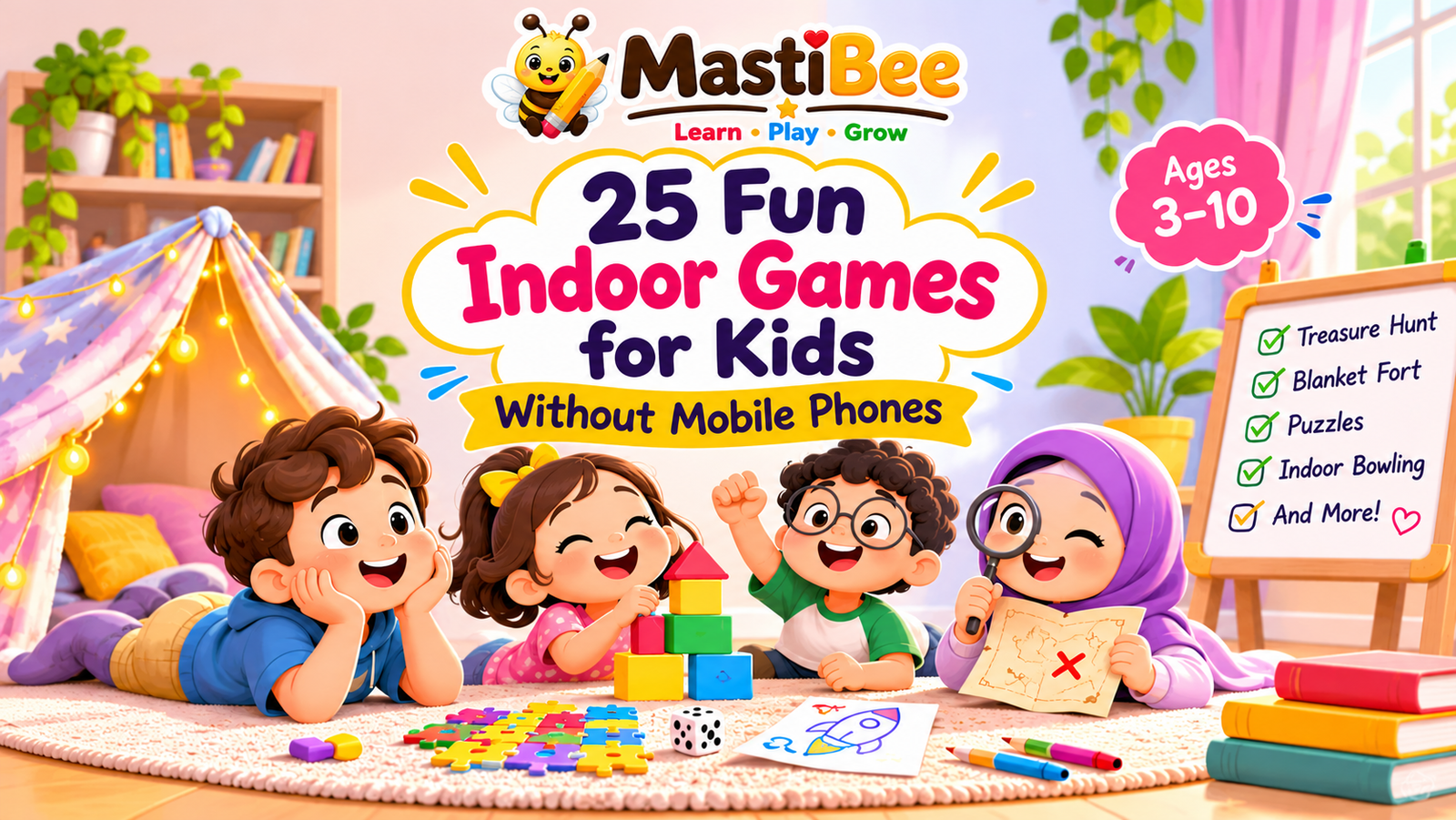
In this guide, we’ve collected 25 fun indoor games for kids without mobile phones. These activities are suitable for children aged 3–10 and encourage creativity, problem-solving, movement, communication and independent play.
Let’s make screen-free time something your children actually look forward to!
- Why Should Parents Encourage Screen-Free Indoor Games?
- 25 Best Indoor Games for Kids Without Mobile Phones
- 1. Indoor Treasure Hunt
- 2. Build a Blanket Fort
- 3. Colour Sorting Challenge
- 4. Balloon Volleyball
- 5. Guess the Animal
- 6. Indoor Bowling
- 7. The Floor Is Lava
- 8. Storytelling With Toys
- 9. DIY Paper Airplanes
- 10. Simon Says
- 11. DIY Puzzle Challenge
- 12. Indoor Obstacle Course
- 13. Memory Tray Game
- 14. Draw and Guess
- 15. Musical Statues
- 16. Shape Hunt
- 17. Paper Cup Tower Challenge
- 18. What's Inside the Box?
- 19. Make Your Own Comic Book
- 20. Alphabet Hunt
- 21. Indoor Mini Basketball
- 22. Follow the Leader
- 23. DIY Nature Collage
- 24. Guess the Sound
- 25. Educational Worksheet Challenge
- How to Keep Kids Entertained Without Mobile Phones
- Sample Screen-Free Activity Schedule for Kids
- Frequently Asked Questions
- Make Every Day a Learning Adventure With MastiBee!
Why Should Parents Encourage Screen-Free Indoor Games?
Mobile phones can be useful learning tools when used appropriately, but children also need opportunities to explore the world through hands-on experiences.
Screen-free games offer several opportunities for development:
- Creativity: Drawing, storytelling and pretend play encourage imagination.
- Problem-solving: Puzzles, building challenges and treasure hunts develop thinking skills.
- Physical activity: Indoor movement games help children stay active.
- Communication: Group games encourage listening, speaking and teamwork.
- Independence: Simple activities help children learn to entertain themselves.
The goal isn’t to eliminate every screen from your child’s life. It’s to create a healthy balance between digital entertainment and meaningful play.
25 Best Indoor Games for Kids Without Mobile Phones
1. Indoor Treasure Hunt
Age: 4–10 years
Turn your home into an exciting treasure-hunting adventure!
Hide small toys, colourful blocks or paper clues in different safe locations around the house. Give your child the first clue and let them discover the hidden treasure.
How to play:
- Hide 5–10 objects around the room.
- Prepare simple clues such as “Look where we keep our books.”
- Let your child follow the clues.
- Celebrate when they discover the treasure.
Learning benefit: Observation, reading comprehension and logical thinking.
2. Build a Blanket Fort
Age: 3–10 years
Children love having their own little world!
Use blankets, pillows, chairs and cushions to create a cosy indoor fort. Add a few storybooks, soft toys and a small flashlight.
Encourage your child to design their own secret hideout.
Learning benefit: Creativity, spatial awareness and imaginative play.
3. Colour Sorting Challenge
Age: 2–6 years
This simple activity makes learning colours exciting.
Collect colourful blocks, toys, bottle caps or paper pieces. Ask your child to sort them into different colour groups.
Make it more interesting by setting a timer and challenging them to find all the red objects first.
Learning benefit: Colour recognition, classification and visual discrimination.
4. Balloon Volleyball
Age: 4–10 years
Who says you need a playground to enjoy volleyball?
Blow up a balloon and use a piece of string as a pretend net. Let your children hit the balloon back and forth without allowing it to touch the floor.
Learning benefit: Hand-eye coordination, balance and movement.
Safety tip: Supervise young children and keep deflated or broken balloons away from toddlers.
5. Guess the Animal
Age: 3–8 years
One player acts like an animal while everyone else tries to guess what it is.
Can your child walk like an elephant, jump like a rabbit or roar like a lion?
Take turns acting and guessing.
Learning benefit: Vocabulary, imagination and communication.
6. Indoor Bowling
Age: 3–10 years
You don’t need expensive bowling equipment.
Arrange six empty plastic bottles like bowling pins. Use a soft ball to knock them down.
Count the pins and keep a friendly scoreboard.
Learning benefit: Counting, coordination and basic number skills.
7. The Floor Is Lava
Age: 4–10 years
This classic game can turn an ordinary living room into an adventure!
Place cushions or safe stepping mats on the floor. Children must move from one side of the room to the other without touching the floor.
Learning benefit: Balance, movement and strategic thinking.
8. Storytelling With Toys
Age: 3–8 years
Gather your child’s favourite dolls, animals or action figures.
Ask them to create a story using three characters. Give them a fun opening:
“Once upon a time, a little rabbit discovered a mysterious box…”
Let your child decide what happens next.
Learning benefit: Language development, imagination and storytelling skills.
9. DIY Paper Airplanes
Age: 5–10 years
Teach your child how to fold a simple paper airplane.
Make different designs and see which airplane travels the farthest.
Ask questions such as:
- Which airplane flew farther?
- What happens when we fold the wings differently?
- Can we improve our design?
Learning benefit: Creativity, experimentation and early STEM thinking.
10. Simon Says
Age: 3–8 years
One person becomes Simon and gives instructions.
For example:
- Simon says touch your nose.
- Simon says jump three times.
- Touch your head!
Children should only follow instructions that begin with “Simon says.”
Learning benefit: Listening, concentration and following instructions.
11. DIY Puzzle Challenge
Age: 4–10 years
Take an old picture, drawing or printed worksheet and cut it into several large pieces.
Mix them up and ask your child to put the picture back together.
Start with fewer pieces and gradually increase the difficulty.
Learning benefit: Visual reasoning, patience and problem-solving.
12. Indoor Obstacle Course
Age: 4–10 years
Create a mini obstacle course using cushions, cardboard boxes and safe household objects.
Ask children to:
- Walk around cushions.
- Crawl through a cardboard tunnel.
- Jump over a soft pillow.
- Balance along a marked line.
Learning benefit: Gross motor skills, balance and coordination.
13. Memory Tray Game
Age: 4–10 years
Place 8–10 familiar objects on a tray.
Give your child 30 seconds to observe them. Cover the tray and ask them to name as many objects as possible.
For an extra challenge, secretly remove one object and ask what’s missing.
Learning benefit: Memory, attention and observation.
14. Draw and Guess
Age: 4–10 years
One person draws an object while the others guess what it is.
Start with simple things such as:
- Sun
- House
- Cat
- Tree
- Flower
You don’t need to be an artist. The fun comes from guessing!
Learning benefit: Drawing, visual communication and vocabulary.
15. Musical Statues
Age: 3–10 years
Play some music and let everyone dance.
When the music stops, everyone must freeze like a statue. Anyone who moves gets a funny challenge!
Learning benefit: Body control, listening and coordination.
16. Shape Hunt
Age: 3–7 years
Ask your child to find objects around the house that match different shapes.
For example:
- Circle – Clock
- Rectangle – Book
- Square – Cushion
- Triangle – Hanger
Make it a race to find five different shapes.
Learning benefit: Shape recognition and visual learning.
17. Paper Cup Tower Challenge
Age: 4–10 years
Give your child 15–20 paper cups.
Challenge them to build the tallest tower without making it fall.
Try different structures and compare the results.
Learning benefit: Engineering thinking, patience and problem-solving.
18. What’s Inside the Box?
Age: 3–8 years
Place familiar objects inside a box or cloth bag.
Ask your child to reach inside, feel an object and guess what it is without looking.
Use safe objects with different textures and shapes.
Learning benefit: Sensory exploration, descriptive vocabulary and reasoning.
19. Make Your Own Comic Book
Age: 6–10 years
Give your child blank paper and coloured pencils.
Ask them to create a short comic with three or four scenes.
They can invent superheroes, animals or funny family adventures.
Learning benefit: Writing, storytelling, creativity and sequencing.
20. Alphabet Hunt
Age: 3–7 years
Choose one letter and ask your child to find objects beginning with that sound.
For example, for the letter B:
- Ball
- Book
- Bottle
- Bag
Make the game more challenging by choosing different letters.
Learning benefit: Letter recognition, phonics and vocabulary.
21. Indoor Mini Basketball
Age: 4–10 years
Place a laundry basket at a safe distance and use soft balls or rolled-up socks.
Ask your child to throw the balls into the basket.
Count successful shots and gradually increase the distance.
Learning benefit: Hand-eye coordination and counting.
22. Follow the Leader
Age: 3–8 years
One person becomes the leader and performs simple movements.
Everyone else must copy them.
Try hopping, clapping, marching, stretching and funny dance moves.
Learning benefit: Observation, coordination and social interaction.
23. DIY Nature Collage
Age: 4–10 years
Collect safe natural materials such as fallen leaves, flowers and small twigs.
Give your child paper and glue to create a beautiful nature collage.
Discuss the colours, shapes and textures they discover.
Learning benefit: Nature awareness, creativity and observation.
24. Guess the Sound
Age: 3–8 years
Make everyday sounds without showing the object.
Try clapping, tapping a spoon against a cup or shaking a container with safe contents.
Ask your child to identify the sound.
Learning benefit: Auditory discrimination and concentration.
25. Educational Worksheet Challenge
Age: 3–10 years
Not every learning activity needs to feel like studying!
Give your child an engaging worksheet with colourful illustrations, puzzles, matching activities, tracing exercises or simple maths challenges.
Let them choose an activity and complete it independently or with your help.
Try these activities:
- Alphabet tracing
- Number matching
- Spot the difference
- Mazes
- Word puzzles
- Colour-by-number
Learning benefit: Early literacy, numeracy, fine motor skills and independent learning.
How to Keep Kids Entertained Without Mobile Phones
Introducing screen-free games is one thing. Making children excited about them is another!
Here are five practical tips for parents.
1. Let Children Choose
Give your child two or three activity options. When children participate in choosing an activity, they may feel more motivated to try it.
2. Create a Screen-Free Play Corner
Keep crayons, building blocks, puzzles, storybooks and activity sheets in one accessible place.
Make it easy for children to discover something interesting whenever they feel bored.
3. Participate in Their Games
You don’t need to organise every activity. Sometimes, simply joining your child’s treasure hunt or drawing challenge makes the experience more enjoyable.
4. Introduce a Daily Play Routine
Create a simple routine that includes creative play, physical activities, reading and family time.
Keep it flexible rather than turning playtime into another strict timetable.
5. Celebrate Effort, Not Just Results
Praise your child’s creativity, curiosity and willingness to try.
A simple “I love how you solved that puzzle!” can make a child feel proud of their effort.
Sample Screen-Free Activity Schedule for Kids
Need help organising your child’s day? Here’s a simple routine you can adapt.
| Time | Activity |
|---|---|
| Morning | Drawing and colouring |
| 10:00 AM | Building blocks or puzzles |
| Afternoon | Indoor treasure hunt |
| 4:00 PM | Physical movement games |
| Evening | Storytelling and reading |
| Before bed | Quiet activity worksheets |
Adjust the activities according to your child’s age, school schedule and interests.
Frequently Asked Questions
1. What are the best indoor games for kids without mobile phones?
Some of the best options include treasure hunts, blanket forts, balloon volleyball, puzzles, storytelling, drawing challenges, indoor bowling and educational worksheets.
2. How can I keep my child busy at home without a screen?
Provide a combination of creative activities, physical games, puzzles, reading and hands-on learning. Keep activity materials easily accessible so your child can choose something independently.
3. What indoor games can a 5-year-old play at home?
A 5-year-old can enjoy colour sorting, Simon Says, shape hunts, indoor bowling, memory games, storytelling and simple treasure hunts.
4. How do I reduce my child’s dependence on mobile phones?
Start gradually. Introduce enjoyable alternatives, establish consistent screen-time boundaries and participate in screen-free activities together. Avoid making the transition feel like punishment.
5. Are educational worksheets good for children?
Yes. Age-appropriate worksheets can provide opportunities to practise early literacy, maths, handwriting, observation and problem-solving. They work especially well when combined with play and practical activities.
Make Every Day a Learning Adventure With MastiBee!
At MastiBee, we believe childhood should be filled with curiosity, creativity and joyful learning.
Children learn through exploring, experimenting, drawing, building and playing. That’s why we’re passionate about creating engaging educational resources that make learning feel like fun.
Discover our collection of:
- Printable activity worksheets
- Colouring pages
- Alphabet and phonics activities
- Maths practice sheets
- Educational activity books
- Creative learning resources
Whether your child loves solving puzzles, exploring letters or creating colourful artwork, there’s always something new to discover.
Give your little learner more reasons to explore, imagine and create!
Explore MastiBee’s learning resources and make screen-free playtime more meaningful.
Visit: https://mastibee.com/
Happy playing, happy learning!
— Team MastiBee 🐝