You sit your six-year-old down with a worksheet or puzzle. You walk across the room to grab a glass of water, and when you return, your child is upside down on the sofa, playing with a shoelace or asking for a snack!
Many parents wonder: “Why can’t my child focus for even ten minutes, when they can watch cartoons for much longer?”
The difference is that watching a fast-moving video and completing a real-world activity involve different kinds of attention. Videos provide changing images and sounds, while activities such as reading, colouring and solving puzzles often require children to direct their own attention and stay with a task.
The good news is that focus develops gradually. With realistic expectations, a supportive environment and playful practice, you can help your child build concentration without turning every activity into a battle.
1. Understand Your Child’s Developing Attention Span
There is no single attention-span number that every child of a particular age should meet.
A three-year-old may happily spend several minutes building a tower, while an eight-year-old may stay absorbed in a favourite drawing project for much longer. The same child may also concentrate differently depending on whether an activity feels interesting, difficult, familiar or tiring.
A useful approach is to observe your child’s current abilities:
- Ages 3–4: Try short activities such as sorting colours, matching cards, simple puzzles and picture books.
- Ages 5–6: Introduce slightly longer activities such as mazes, drawing, building blocks and simple worksheets.
- Ages 7–8: Encourage multi-step puzzles, reading, creative projects and age-appropriate learning tasks.
These are activity suggestions, not strict developmental limits.
Parent tip: Notice when your child is most engaged. Use that as a starting point instead of comparing their concentration with another child’s.
2. Shrink the Task, Not the Expectation
Imagine telling an energetic six-year-old, “Finish all five pages of homework!”
That can feel overwhelming before they even begin.
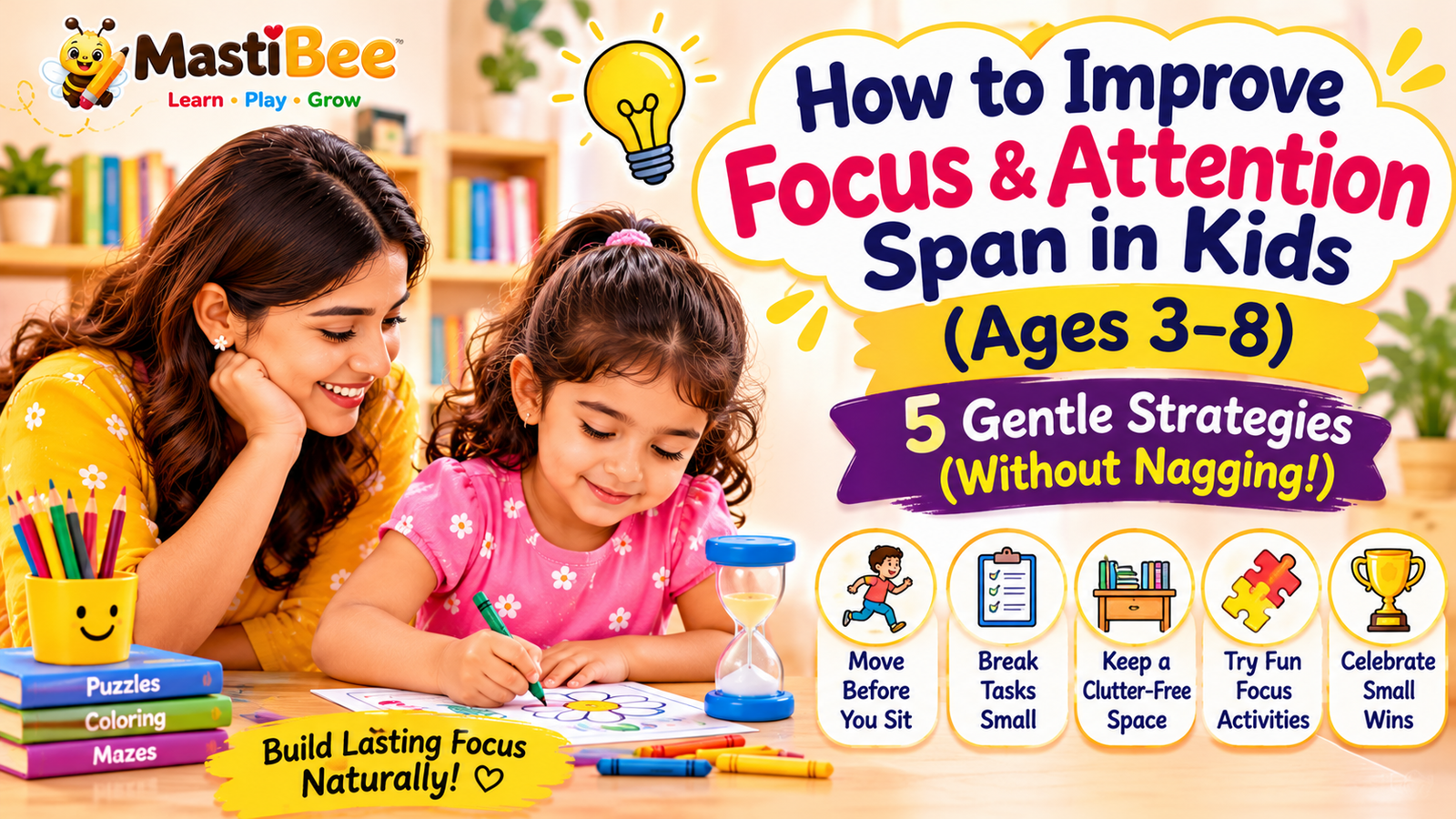
Instead, divide the work into smaller, achievable steps.
Try the One-Page Win approach:
- Place just one worksheet or activity on the table.
- Explain the task in one or two simple sentences.
- Let your child complete that section.
- Offer a short break before moving to the next activity.
You can also use a visual timer, such as a small sand timer, to show when an activity will finish.
Start with a manageable period and adjust it according to your child’s response. The aim is to create a positive sense of progress, not to force concentration for a fixed number of minutes.
3. Let the Body Move Before Sitting Down
Children do not always want to sit still immediately after school, outdoor play or a long journey.
Before quiet activities, try a short movement break:
- Frog jumps across the room
- Dancing to one favourite song
- Wall push-ups
- Walking like a bear or crab
- Carrying a light stack of books with supervision
After moving, invite your child to sit down for a puzzle, story or colouring activity.
Movement breaks provide an opportunity to release energy and transition between activities. They do not need to be complicated or intense.
4. Create a Clutter-Free Focus Zone
A busy table can make it harder for a young child to know where to begin.
Create a simple activity space with:
- One worksheet, book or puzzle
- A small cup of crayons or pencils
- A comfortable chair and suitable table
- Good lighting
- Fewer toys and unnecessary distractions nearby
Put televisions and mobile devices away during the activity.
Keep the setup consistent so your child begins to recognise the space as a place for drawing, reading, puzzles or quiet learning.
Parent tip: Let your child help arrange the activity area. Giving them a small responsibility can make the routine feel more inviting.
5. Build Focus Through Playful Activities
Children are more likely to stay engaged when an activity feels enjoyable and achievable.
Try these screen-free activities:
- Dot-to-dot puzzles: Encourage children to follow a sequence carefully.
- Visual mazes: Help them plan a route and notice details.
- Spot-the-difference games: Encourage observation and comparison.
- Mandala colouring: Give children an opportunity to practise careful colouring and sustained engagement.
- Memory matching cards: Encourage children to remember locations and patterns.
- Building challenges: Ask your child to create a tower, bridge or shape using blocks.
Start with an activity your child enjoys. As they become comfortable, gradually introduce slightly more challenging tasks.
Celebrate effort and persistence rather than demanding perfect results.
Make Screen-Free Focus Fun with MastiBee!
Looking for simple activities to add to your child’s daily routine?
Explore MastiBee’s printable learning resources:
- 50+ Relaxing Mandala Coloring Book – ₹99: A collection of colouring pages for creative, screen-free activity time.
- Grade 1 Math & English Workbooks – ₹149: Printable learning activities, puzzles and practice pages for early learners.
Choose activities that match your child’s age and ability, and let them enjoy learning at their own pace.
Download instantly at MastiBee and make everyday learning more playful!
Frequently Asked Questions
1. How can I improve my child’s attention span?
Offer short, age-appropriate activities, reduce distractions, include movement breaks and gradually introduce more challenging tasks. Encourage progress without pressuring your child.
2. Why can my child watch cartoons but not finish a worksheet?
Watching videos and completing worksheets involve different demands. Videos provide continuous external stimulation, while worksheets require children to direct their own attention and work through a task.
3. What activities improve focus in children?
Mazes