Once children can read simple three-letter CVC words like cat, hop and pin, they are ready to explore longer words. Soon, they encounter words such as frog, star, clap, blue and train.
For many Grade 1 readers, these words can be tricky. A child might read STOP as “suh-top”, skip one of the consonants or pause between the two beginning sounds.
Why does this happen?
The challenge is learning to recognise two consonant sounds together without adding an extra vowel sound between them.
Unlike digraphs such as SH and CH, where two letters represent one sound, a consonant blend contains two or more consonants whose individual sounds can still be heard.
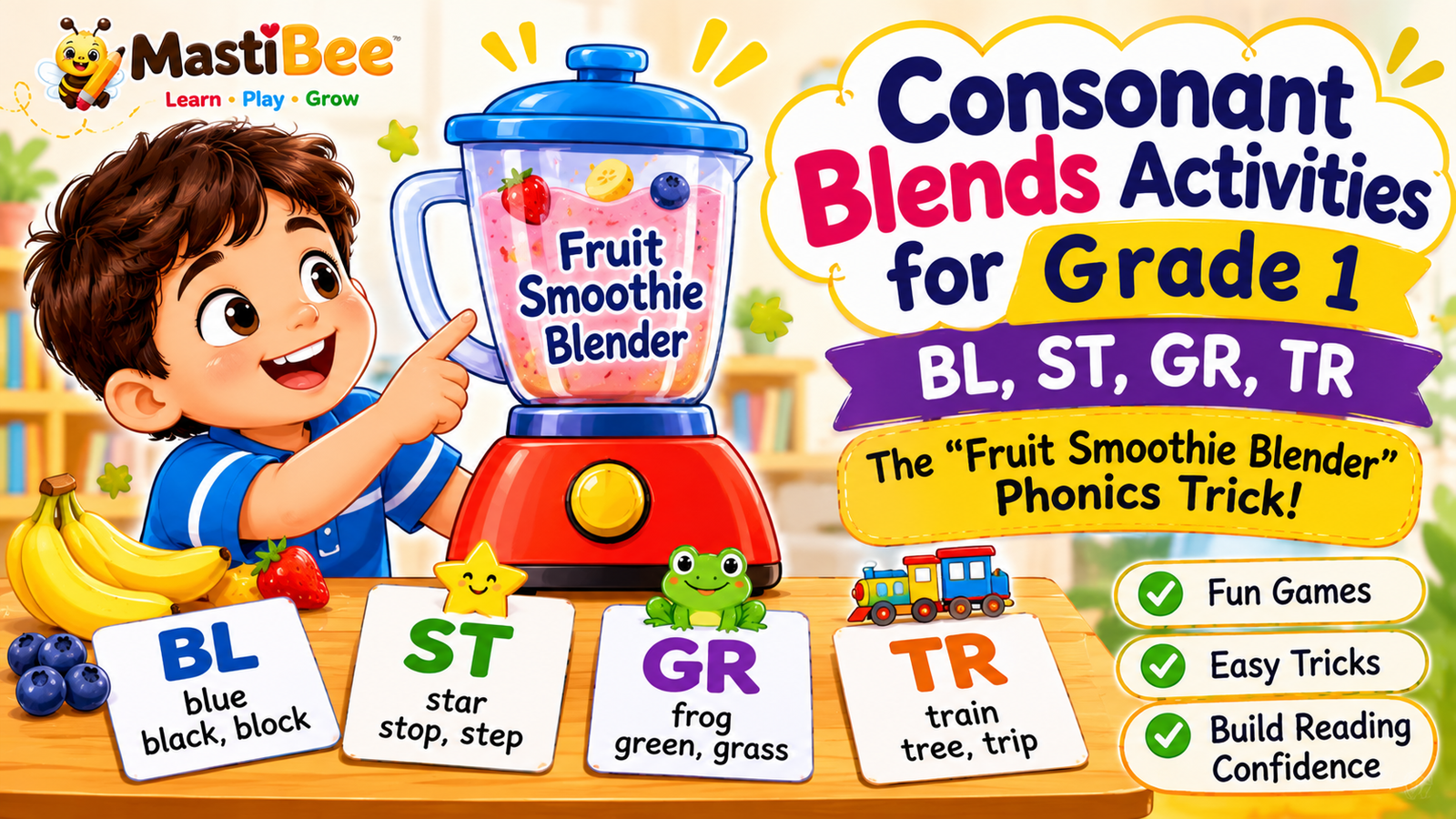
The good news? You can make this concept easier with the playful Fruit Smoothie Blender Phonics Trick!
Here are five hands-on consonant blend activities for Grade 1 readers.
1. The “Fruit Smoothie Blender” Analogy
Imagine putting a banana and a lime into a kitchen blender.
When you blend them together, you get one smoothie. The flavours mix, but you can still taste both ingredients!
Consonant blends work in a similar way. The sounds move smoothly together, but each consonant keeps its own sound.
Try these examples:
- BL – Banana + Lime: Say /b/ and /l/ smoothly together in blue, black and block.
- ST – Strawberry + Tomato: Blend /s/ and /t/ in star, stop and step.
- FR – Fruit + Raspberry: Blend /f/ and /r/ in frog, fruit and from.
- GR – Grapes + Raspberry: Blend /g/ and /r/ in grape, grass and green.
Now compare blends with digraphs:
- BL: You can hear /b/ and /l/ separately.
- SH: The two letters work together to represent one sound.
Tell your child: “In a blend, both sounds keep their voices. They just move together quickly!”
2. Try the “Arm Slide” Blending Motion
Turn phonics practice into a movement activity.
How to play:
- Ask your child to stretch out one arm.
- Tap the shoulder and say the first sound, such as /f/.
- Tap the elbow and say the second sound, /r/.
- Tap the wrist and say the remaining word part, /og/.
- Slide your other hand smoothly from shoulder to wrist while saying “frog”.
Repeat with words such as:
- /b/ + /l/ + /ack/ = black
- /s/ + /t/ + /op/ = stop
- /g/ + /r/ + /ass/ = grass
- /t/ + /r/ + /ain/ = train
Encourage your child to say the sounds without inserting an extra “uh” between them.
The aim is smooth blending, not rushing through the word.
3. Meet the Three Big Blend Families
Organising consonant blends into families makes practice easier.
L-Blends
The second sound is /l/.
Examples include:
- BL – blue, black
- CL – clap, clock
- FL – flag, flip
- GL – glad, glass
- PL – plug, plan
- SL – sled, slip
R-Blends
The second sound is /r/.
Examples include:
- BR – brush, brick
- CR – crab, crop
- DR – drum, dress
- FR – frog, fruit
- GR – green, grass
- TR – train, tree
S-Blends
These begin with /s/ followed by another consonant sound.
Examples include:
- SC – scan, scarf
- SK – skip, skate
- SM – smile, small
- SN – snake, snap
- SP – spin, spot
- ST – star, stop
- SW – swim, swing
Parent tip: Introduce just one blend family at a time. Let your child become familiar with a few words before introducing another group.
4. Make a DIY “Cup and Spin” Blend Wheel
Create a simple word-building game using two paper cups.
What you need:
- Two paper cups
- A marker
- Scissors and adult supervision
How to play:
- Write beginning blends such as BL, CL, FL, SL and TR around the rim of one cup.
- On the second cup, write compatible word endings such as -ACK, -AP, -IP, -EE and -AIN.
- Place one cup inside the other so your child can rotate it.
- Let your child spin the cups to create word combinations.
- Ask them to read each combination aloud.
Examples include:
- CL + AP = CLAP
- FL + AP = FLAP
- SL + IP = SLIP
- TR + AIN = TRAIN
Some combinations will create silly or unfamiliar words. Treat these as playful sound experiments, then ask your child to identify which combinations make real words.
5. Reinforce Learning with Blend Sorting and Phonics Worksheets
A little extra practice can help children recognise blends in different words.
Try these activities:
- Picture-to-blend matching: Match a picture of a frog to FR.
- Word sorting: Group words into L-blends, R-blends and S-blends.
- Missing-blend puzzles: Complete _og, _ap and _ar with the correct beginning sounds.
- Blender mazes: Follow the correct blend to reach a matching picture.
- Colouring challenges: Colour pictures according to their beginning blends.
Keep activities short and enjoyable. Encourage your child to sound out each word rather than simply memorising its spelling.
Build Reading Confidence with MastiBee!
Ready to make phonics practice more exciting?
Explore the MastiBee Grade 1 English & Reading Workbook, featuring 30 colourful pages of phonics quests, consonant blend activities, Stealthy Y rules and 50 sight words.
Designed to make early reading practice engaging, this printable workbook gives children opportunities to explore sounds, recognise words and build reading confidence.
Download your high-resolution printable PDF for just ₹149!
Visit MastiBee and make every reading adventure more fun.
Frequently Asked Questions
1. What are consonant blends in Grade 1?
Consonant blends are groups of two or more consonants placed together in a word, where each consonant sound can still be heard. Examples include BL in black, ST in stop and GR in green.
2. What is the difference between a consonant blend and a digraph?
In a consonant blend, each consonant keeps its individual sound, as in BL. In a digraph, two letters work together to represent one sound, as in SH or CH.
3. What are the three main types of beginning consonant blends?
Common beginning blends are grouped into L-blends, R-blends and S-blends. Examples include CL, FR and ST.
4. How can I teach consonant blends at home?
Use sound blending, arm movements, picture cards, word sorting and simple word-building games. Start with familiar words and practise a small number of blends at a time.
5. At what age should children learn consonant blends?
Many children begin learning common consonant blends during kindergarten and Grade 1, depending on their reading development and phonics instruction. Introduce them gradually and provide plenty of opportunities to practise.