
| NEP 2020 (National Education Policy) introduces: a new 5+3+3+4 school structure replacing 10+2, mother tongue as medium of instruction until Grade 5, no rigid stream separation after Class 10, emphasis on foundational literacy and numeracy by Grade 3, and vocational training from Class 6. The policy is being implemented gradually from 2020 to 2030. |
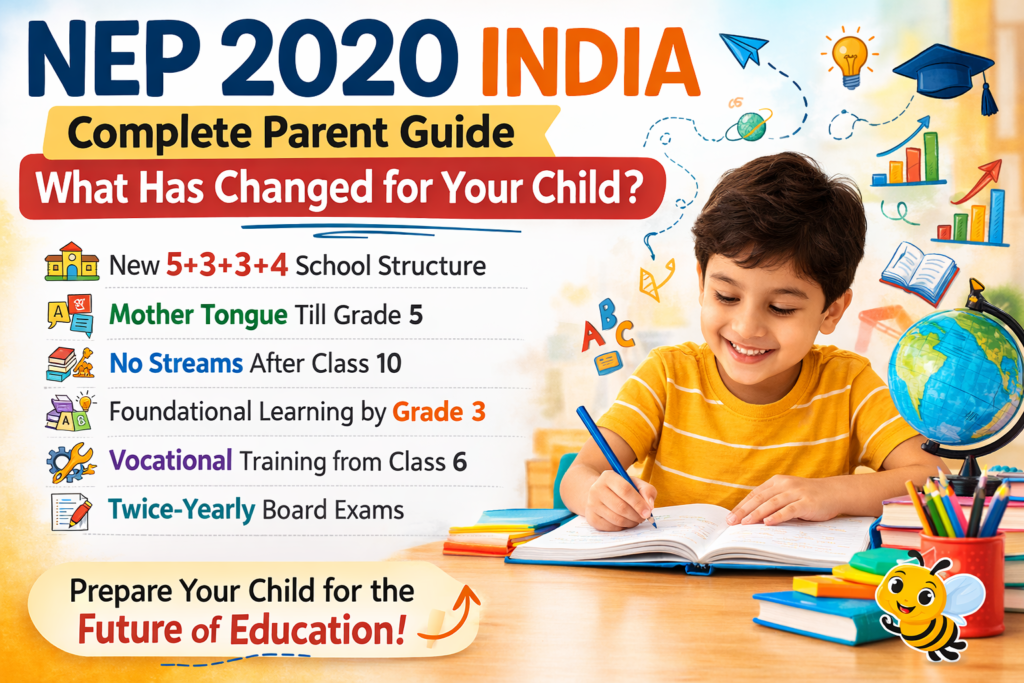
India’s National Education Policy 2020 is the most significant transformation of the Indian education system since 1986. India approved NEP 2020 in July 2020 and is gradually implementing it nationwide, affecting every child from nursery to university.. Yet most Indian parents have only a vague understanding of what has changed and how it affects their child’s education today.
This plain-language guide explains everything Indian parents need to know about NEP 2020 — what changed, what it means for your child’s daily school life, and how to support your child under the new framework.
The New 5+3+3+4 School Structure
The most fundamental change in NEP 2020 is the replacement of the traditional 10+2 school structure with a new 5+3+3+4 system:
| Stage | Years | Ages | What It Covers |
| Foundational Stage | 5 years | Ages 3-8 | Nursery, LKG, UKG, Class 1, Class 2 — play-based learning |
| Preparatory Stage | 3 years | Ages 8-11 | Class 3-5 — experiential learning, activity-based |
| Middle Stage | 3 years | Ages 11-14 | Class 6-8 — subject teachers, critical thinking |
| Secondary Stage | 4 years | Ages 14-18 | Class 9-12 — multidisciplinary, no rigid streams |
The 8 Biggest Changes Under NEP 2020
Change 1 — Mother Tongue as Medium of Instruction Until Grade 5
NEP 2020 strongly recommends mother tongue or regional language as the medium of instruction until at least Grade 5 — and ideally Grade 8. This is a significant shift from the English-medium dominance of previous decades. Research consistently shows that children learn faster and more deeply in their mother tongue in the foundational years. English is still taught as a subject from Class 1.
Change 2 — No Rigid Stream Separation After Class 10
The traditional Science/Commerce/Arts stream separation after Class 10 is being dismantled. Under NEP 2020, students in Class 11-12 can choose from a flexible combination of subjects across traditional stream boundaries. A student can study Physics, Accountancy and Music simultaneously.
Change 3 — Foundational Literacy and Numeracy by Grade 3
NEP 2020 sets a national target: every child in India will achieve basic literacy and numeracy by Grade 3 (approximately age 8-9). The Government of India launched NIPUN Bharat, a national mission to ensure every child learns basic reading and math by Grade 3.
This makes early literacy and numeracy support — including quality practice materials at home — more important than ever.
Change 4 — Play-Based Learning in Foundational Years
The Foundational Stage (nursery to Class 2) is shifting from formal instruction to play-based, activity-based learning. Under NEP 2020, schools replace rote memorization with hands-on activities, storytelling, art, and games.. This directly validates approaches like coloring books, activity workbooks, and educational games.
Change 5 — Vocational Training from Class 6
Starting in Class 6, students learn practical skills like cooking, carpentry, electronics, and gardening as part of their curriculum. The aim is to remove the social stigma from vocational education and ensure every student has practical skills alongside academic knowledge.
Change 6 — Reduced Curriculum Load
NEP 2020 mandates a reduction in the volume of curriculum content in favour of deeper understanding. NEP 2020 promotes a “less is more” approach, encouraging schools to teach fewer topics with deeper conceptual understanding instead of rote memorization.
Board exams will test application and higher-order thinking rather than rote recall.
Change 7 — Report Cards Replace Traditional Marks
Under NEP 2020, schools now evaluate students through holistic progress reports rather than traditional mark-based report cards, assessing academics, physical fitness, emotional development, the arts, and sports. This comprehensive assessment reflects the whole child rather than just examination performance.
Change 8 — Twice-Yearly Board Exams from 2025-26
Class 10 and 12 board exams will be offered twice a year, with students able to keep their better score. This dramatically reduces the single-examination anxiety that has caused immense stress — and, tragically, student suicides — in India.
What NEP 2020 Means for Parents — Practical Implications
| Your Child’s Situation | What NEP Means for You | Action to Take |
| Child in Nursery-Class 2 | Play-based learning emphasis — less rote, more activity | Choose activity-based materials: coloring, workbooks with illustrations |
| Child in Class 3-5 | Foundational literacy/numeracy focus — NIPUN Bharat | Extra practice in reading and math at home — 20 min/day |
| Child in Class 6-8 | Vocational exposure introduced | Encourage exploration, don’t over-specialize early |
| Child in Class 9-10 | No stream decision pressure immediately | Explore interests broadly before Class 11 choices |
| Child in Class 11-12 | Can mix subjects across streams | Research flexible subject combinations with school |
Frequently Asked Questions
Q: Is NEP 2020 implemented in all schools in India right now?
NEP 2020 is being implemented gradually. CBSE and many state governments have begun implementation, particularly for foundational stages. Full implementation across all states and all stages is expected by 2030. Check with your child’s specific school for current status.
Q: Does NEP 2020 affect private schools or only government schools?
NEP 2020 applies to all schools in India — government and private. CBSE has already begun aligning its curriculum with NEP principles. ICSE and state boards are at various stages of alignment.
Q: My child is in Class 1 — should I change their school because of NEP?
No need to change schools. Focus instead on ensuring your child’s school is moving toward play-based, activity-rich learning at the foundational stage. Supplement at home with quality activity materials that align with NEP’s emphasis on experiential learning.
| ‘NEP 2020 emphasises foundational literacy and numeracy — our Grade 1 Math Workbook is perfectly aligned. Download for ₹149. Link to Math Workbook’ |
| ‘NEP values creative, activity-based learning — our coloring books develop exactly the skills NEP prioritises. From ₹79. Link to coloring books’ |
NEP 2020 is India’s most ambitious education reform in 35 years and embraces a principle research has long proven: children learn best through play, activity, exploration, and joy.. Parents who support this approach at home — through quality workbooks, coloring, reading and play — are already implementing the spirit of NEP 2020.MastiBee Kids printable workbooks and coloring books support the NEP 2020 learning approach by encouraging play-based, creative, and activity-driven learning. 🐝