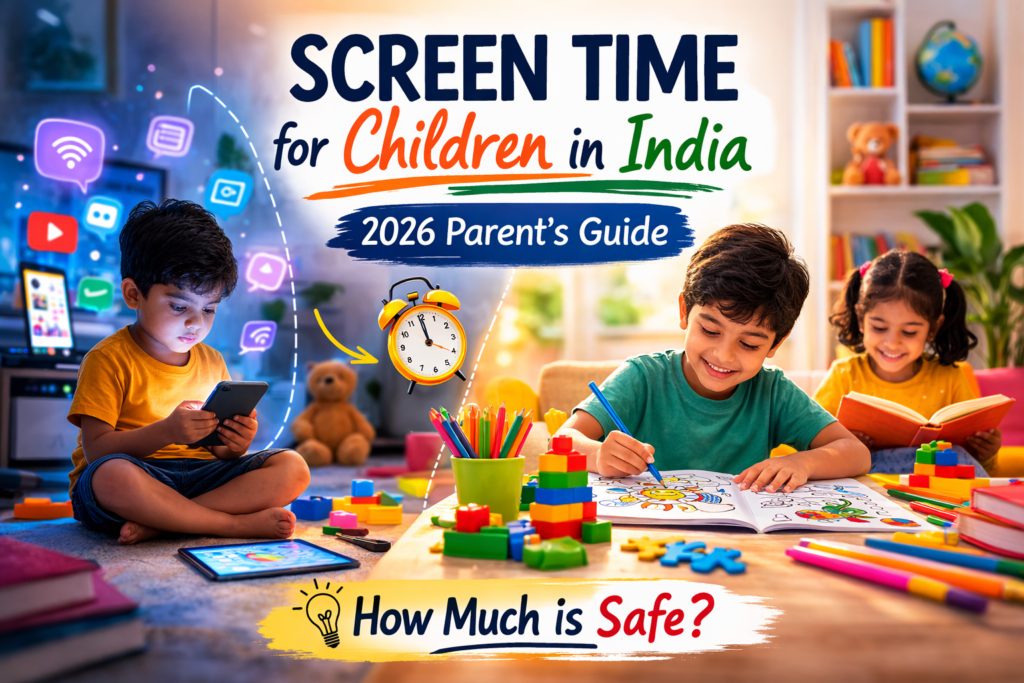
| Indian pediatricians recommend: No screens for children under 2. Maximum 1 hour/day for ages 2-5. Maximum 2 hours/day for ages 6-12. Quality matters more than quantity — educational content is preferable to passive entertainment. Screen-free activities like coloring, outdoor play and reading should replace reduced screen time. |
Screen time has become the defining parenting challenge of our generation — and in India, where smartphones are ubiquitous and children grow up with them in hand, the question ‘how much screen time is too much for my child?‘ has never been more urgent. Indian parents are increasingly worried about mobile addiction, reduced attention spans, disrupted sleep, and delayed social development — all linked to excessive screen exposure in young children.
In this comprehensive guide, we share current Indian and international guidelines, the real effects of excessive screen time, age-specific recommendations, and — most importantly — practical screen-free alternatives that Indian children actually enjoy.
Official Screen Time Guidelines for Indian Children
| Age Group | Maximum Screen Time | Type of Screen Allowed | Source |
| Under 18 months | Zero (video calls with family only) | Video calling only | IAP 2022 Guidelines |
| 18-24 months | Minimal — with parent present | High-quality educational only | WHO / IAP |
| 2-5 years | 1 hour per day maximum | Educational, co-viewed with parent | WHO Guidelines |
| 6-12 years | 2 hours per day maximum | Educational + entertainment mix | AAP / IAP |
| 12+ years | Consistent limits + monitoring | With parental oversight | IAP 2022 |
IAP = Indian Academy of Pediatrics. WHO = World Health Organization. AAP = American Academy of Pediatrics.
Signs Your Child Has Too Much Screen Time
- Tantrums when device is taken away — disproportionate emotional response
- Difficulty concentrating on non-screen activities for more than 5 minutes
- Disrupted sleep — difficulty falling asleep or waking at night
- Reduced interest in outdoor play and physical activity
- Withdrawal from family conversations and social interaction
- Delayed speech development (for children under 3)
- Eye strain, headaches, or complaints about vision
Healthy Screen Alternatives for Indian Children
Ages 2-5: Best Screen-Free Activities
- Printable coloring books — fine motor development, creativity, calm focus
- Playdough sculpting — sensory development and imagination
- Puzzle solving — spatial reasoning and patience
- Picture book reading — language development and parent bonding
- Outdoor time — even 30 minutes morning and evening is transformative
Ages 6-10: Best Screen-Free Activities
- Math workbooks — keeps academic skills sharp, builds confidence
- Board games — strategy, social skills, and family bonding
- Coloring books (Mandala for older children) — focus and mindfulness
- Building with blocks or LEGO — spatial reasoning and creativity
- Sports or dance — physical development and teamwork
We at mastibee help Parents to make kids interactive . We have several printable books at low cost . Checkout Here at mastibee.com
How to Reduce Screen Time Without Battles
- Set clear, consistent rules — ‘screen time is after homework, before dinner, for 45 minutes’
- Give 10-minute warnings — ‘in 10 minutes we turn off the tablet’ — reduces resistance
- Replace, don’t just remove — have an alternative activity ready immediately
- Create phone-free zones — dining table, bedroom, first 30 minutes after school
- Model the behavior — children mirror parents’ phone usage closely
- Earn screen time — 30 minutes outdoor play or reading = 30 minutes screen time
Frequently Asked Questions
Q: Is educational screen time different from entertainment screen time?
Yes, significantly. Active educational apps like Khan Academy Kids or interactive learning games where children respond, solve problems and create are far less harmful than passive entertainment (YouTube videos). However, even educational screen time should respect the age-based limits above.
Q: My child watches educational videos on YouTube — is that harmful?
Educational YouTube content is preferable to pure entertainment, but passive viewing — even of educational content — provides less developmental benefit than interactive, hands-on activities. Balance YouTube learning with printable worksheets, coloring, and physical play.
| ‘Replace 30 minutes of daily screen time with our printable coloring books — from ₹79. Instant download, print at home. Download Here |
Managing screen time for Indian children is not about eliminating technology — it is about balance. Following age-appropriate guidelines, replacing screen time with genuinely engaging offline activities, and modeling healthy habits ourselves gives our children the best of both worlds. For parents looking for quality screen-free activities, our Mastibee Kids printable workbooks and coloring books provide engaging, educational alternatives that children actually request. 🐝